How often commercial grease traps need cleaning in Perth, the 25% rule, what drives the cost of a service, and how to pick a licensed Controlled Waste Carrier.
BY FREMANTLE RESOURCE SOLUTIONS · 10 MIN READ · UPDATED OCTOBER 2026

How often commercial grease traps need cleaning in Perth, the 25% rule, what drives the cost of a service, and how to pick a licensed Controlled Waste Carrier.
BY FREMANTLE RESOURCE SOLUTIONS · 10 MIN READ · UPDATED OCTOBER 2026
Quick answer. Commercial grease traps in Perth need to be pumped out by a licensed Controlled Waste Carrier before they reach 25% of their total liquid depth. Most restaurants and cafés need a service every four to twelve weeks; high-volume kitchens often need monthly. You cannot legally empty a commercial grease trap yourself in Western Australia. The waste must be transported by a carrier licensed by DWER under the Environmental Protection (Controlled Waste) Regulations 2004.
If you’re a Perth food business owner, café manager, hotel operator, or facilities manager who needs the practical detail, this guide walks through the WA-specific rules, the signs your trap needs servicing, what affects the cost, the actual cleaning process, and how to choose a licensed cleaner. Written by the team at Fremantle Resource Solutions.
IN THIS GUIDE
Years Serving Perth & Fremantle
DWER Controlled Waste Licence
Water Corp Fill Threshold Rule
SECTION 01
A grease trap, sometimes called a grease arrestor or grease interceptor, is a plumbing device that sits between the dirty water leaving your kitchen and the public sewer. Its job is to cool the wastewater down so the fats, oils and grease (FOG) float to the top, the solids sink to the bottom, and only relatively clean water leaves through the outlet.
The trap works because of physics, not filtration. Hot greasy water flows in, the temperature drops, the grease cap forms on top, food solids settle at the base. Over time the grease cap thickens and the solids layer rises. When the combined depth of FOG plus solids reaches around 25% of the total trap depth, the device starts losing efficiency. Beyond that, grease begins spilling through to the sewer with the wastewater.
Water Corporation in Perth requires every commercial premises that produces FOG to install and maintain a grease arrestor. Without one, you can’t legally connect your commercial kitchen to the sewer.
A quick note on terminology. In WA the technically correct term is ‘grease arrestor’, which is the term Water Corporation uses in its Trade Waste rules. ‘Grease trap’ is more common in everyday speech and across the rest of Australia. Both refer to the same device.
SECTION 02
Western Australia’s grease trap rules are governed by Water Corporation’s Trade Waste Compliance Code and the Environmental Protection (Controlled Waste) Regulations 2004. The critical rule is this:
A grease trap must be pumped out before the combined depth of FOG and solids exceeds 25% of the total liquid depth.
What that does not mean:
What it actually means: you need to know how fast your trap fills, and schedule service before it hits the 25% threshold. A 1,500L grease trap servicing a 70-cover suburban café might need quarterly pump-outs. A 1,500L grease trap servicing a 200-cover fast-casual restaurant with deep fryers might need fortnightly pump-outs. Same trap, very different schedules.
Water Corporation trade waste inspectors do check this. The penalty pathway is: notice of non-compliance first, then a fine (up to $5,000 per breach for businesses under WA Environment Protection Act provisions), then a disconnection notice if uncorrected. In serious or repeated breaches, the operator can be charged under the Environmental Protection Act 1986 (WA).
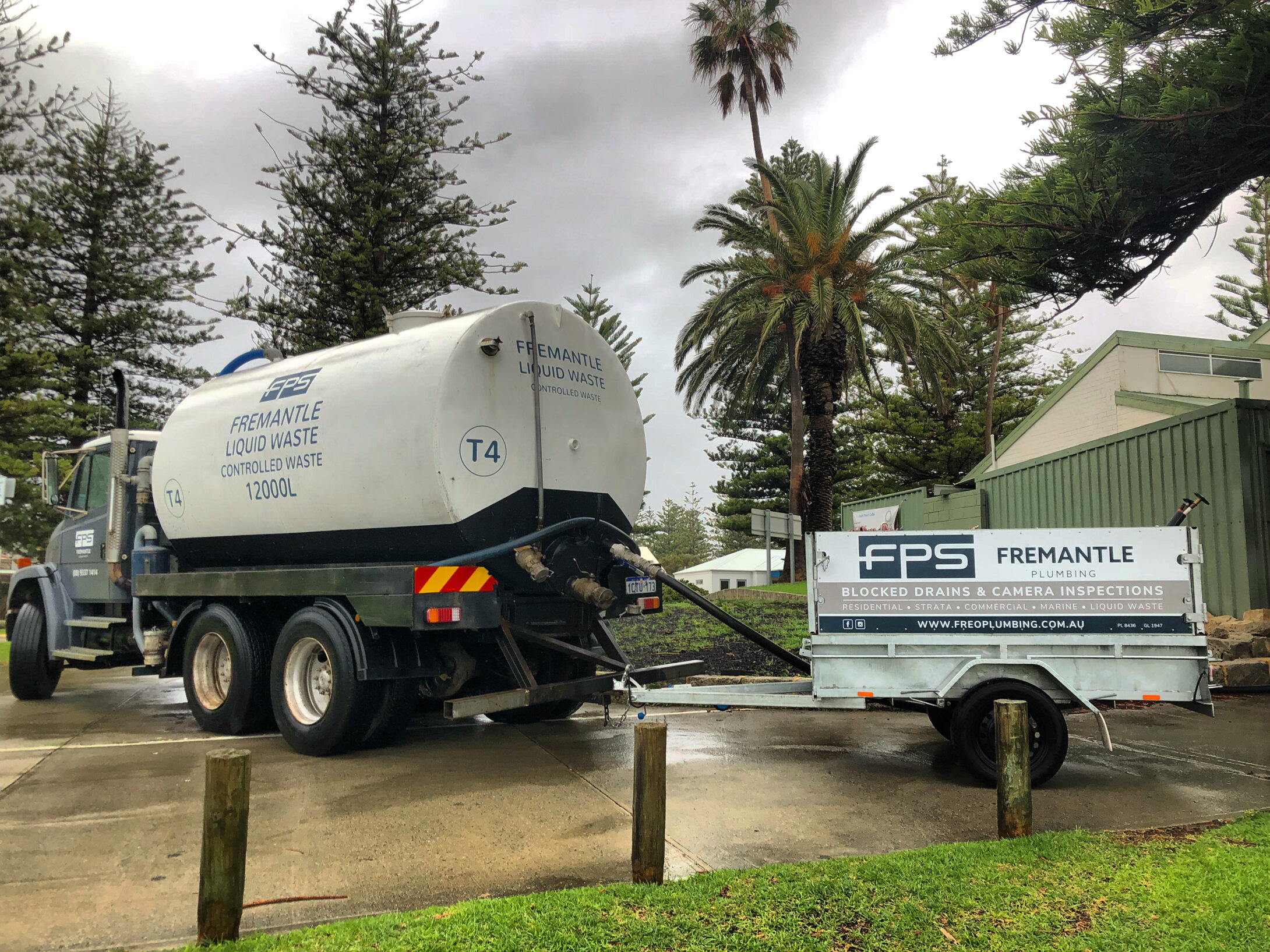
FRS licensed field crew on site in Perth.
SECTION 03
The honest answer is ‘as often as the 25% rule requires’, which depends on your trap size, your kitchen volume, what you cook, and how much FOG your menu produces.
Important: the actual required cleaning frequency for your site is determined by Water Corporation and stipulated on your trade waste permit. The intervals below are practical starting points, but the frequency listed on your permit is the compliance benchmark you must meet. If in doubt, check your permit or ask your carrier to review it with you.
For practical planning, here are the typical service intervals we see across Perth and Fremantle:
These are starting points. We tell every new client: book the first service, then on the day of that service we measure the FOG and solids depth. From that we calculate your specific fill rate and set your service interval so you stay safely under the 25% threshold without paying for services you do not need.
SECTION 04
Even with a scheduled service in place, situations come up that mean an unscheduled pump-out:
If any of these happen, book an emergency clean. Continuing to operate a grease trap that is over the 25% mark exposes the business to fines and pushes grease into the council sewer, which can trigger a separate clean-up bill from Water Corp.
SECTION 05
A typical commercial grease trap clean in Perth takes 45 to 90 minutes for an in-ground trap. The process is the same whether you have a 100L unit under the sink or a 5,000L below-ground arrestor.
Licensed operator arrives in a marked vacuum tanker. They isolate the area, place safety signage, lift the access cover and assess depth and condition. A laser depth gauge or dip stick measures the FOG plus solids percentage.
All contents are pumped from the trap. That is water, grease cap, settled solids, the lot. A full pump-out is the only way to reset the 25% clock. Skimming the top is not compliant.
Once empty, the operator scrapes the walls and baffles, removing hardened grease that the vacuum couldn’t lift. Any food solids stuck in the inlet and outlet baffles are cleared.
With the trap empty, the operator checks for cracking, baffle damage, displaced lids, and inlet/outlet pipe condition. Anything that needs repair is documented.
The trap is refilled with clean water to re-establish the water seal, the lid is replaced, and any disturbed area is cleaned down.
The operator issues a Controlled Waste Tracking Form (also called a CWT) showing waste type, volume, generator (your business), carrier (the cleaner) and destination (an approved facility). Keep this on file. Water Corporation inspectors can ask for two years of CWT records.
Then, Transport to licensed disposal. The waste is taken to a DWER-approved facility for processing. It cannot be dumped, mixed with general waste, or returned to land.
If you are getting quotes from cleaners and someone offers a no-paperwork or skim-only service, walk away. That service is not compliant in WA.
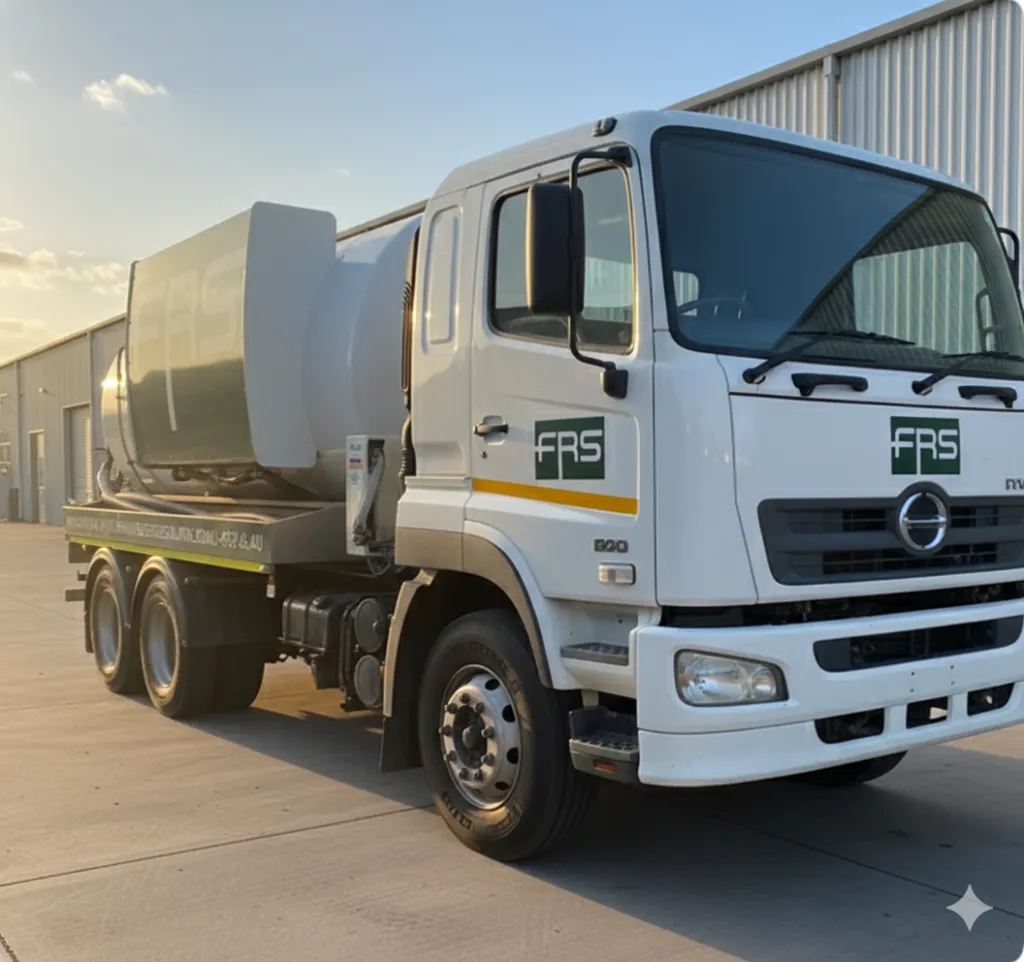
Purpose-built vacuum tanker used for FRS grease arrestor pump-outs.
SECTION 06
Costs vary by trap size, location and access. The main factors are how big your trap is, where it sits on site, whether the truck can get close, and whether it’s a scheduled visit or an emergency call.
The best way to get an accurate figure for your site is to request a written quote from a licensed carrier. A reputable operator will ask about trap size and volume, review site access, and come back to you with a clear scope and price in writing rather than a rough phone estimate.
Things that add cost:
Things that reduce cost over time:
A scheduled contract usually drops the per-service cost 10 to 20% versus ad-hoc bookings, and removes the late-Friday-night panic call when the kitchen backs up before service.
Tell us your site type and trap size. We come back with a written quote, a Water Corp-aligned service interval, and the consignment paperwork that protects your business.
SECTION 07
SECTION 08
For commercial premises, no. The Environmental Protection (Controlled Waste) Regulations 2004 require grease trap waste (categorised as N205 putrescible/organic waste) to be transported by a Controlled Waste Carrier licensed by DWER and disposed of at an approved facility.
A business owner cannot legally:
The licensed cleaner’s truck has a DWER carrier number painted on it for a reason. Without that licence, the transport itself is illegal.
For domestic septic systems or residential greywater traps different rules apply, but if you are operating commercially, the only compliant route is a licensed Controlled Waste Carrier.
SECTION 09
Five questions to ask before you book.
You also want to look at:
Fremantle Resource Solutions has been a licensed Controlled Waste Carrier in WA since 1952 (DWER licence T00004). We service grease arrestors from 100L under-sink units up to 30,000L industrial arrestors across Perth, Fremantle and the surrounding regions, with same-day and out-of-hours availability for urgent calls.
Onsite compliance measurement, cleaning and paperwork in one visit.
SECTION 10
Even with a scheduled service, you can stretch the interval (and save money) with good kitchen habits:
These habits do not eliminate the need for scheduled cleaning, but they meaningfully change your fill rate.
Get a licensed Controlled Waste Carrier looking after your grease arrestor from the first service. Measured fill rate, Water Corp-aligned schedule, paperwork on time, every time.
FAQ
Forty-five minutes to ninety minutes for most commercial traps. Very large arrestors (above 5,000L) or units with heavy solids can take longer.
For most under-sink units no. The trap is offline for the actual pump-out (typically 15 to 20 minutes within the visit). For below-ground arrestors, dishpit and floor drains shouldn’t be used during the pump-out. We schedule outside service hours where possible.
In WA, Water Corporation uses ‘grease arrestor’ in its trade waste rules. ‘Grease trap’ is the more common everyday term. They are the same device.
No. The 25% rule applies to combined FOG plus solids depth, and the solids at the bottom are not removed by skimming. Compliance requires a full pump-out.
The trap continues filling. Once over 25%, grease starts spilling through to the sewer. Water Corp can detect this through their flow monitoring and trace it back to your premises. The consequence is a non-compliance notice, then a fine, then potentially disconnection.
No. The rule is the 25% threshold, not a calendar interval. The interval is whatever frequency keeps you under that threshold. Your cleaner should measure and recommend.
You need a DWER Controlled Waste Carrier licence to transport the waste. The cleaning activity itself doesn’t require a separate licence, but disposal of N205 waste outside an approved facility is an offence.
You will never solve the problem with more frequent cleaning alone. The trap will keep failing every few weeks. Get a sizing review. A new trap is usually $3,000 to $15,000 installed depending on size and access, and it pays for itself within 12 to 24 months in saved service costs and avoided non-compliance.
Yes. Most Perth Controlled Waste Carriers (us included) handle waste oil and grease trap waste together. Single visit, two waste streams, lower overall cost. See waste oil collection.
Two years of Controlled Waste Tracking certificates, your service contract, and any compliance notices from Water Corporation. Keep them in a folder near the kitchen pass for quick access during a trade waste inspection.